With Love, Budapest coming soon, but for now, meet Kirby.
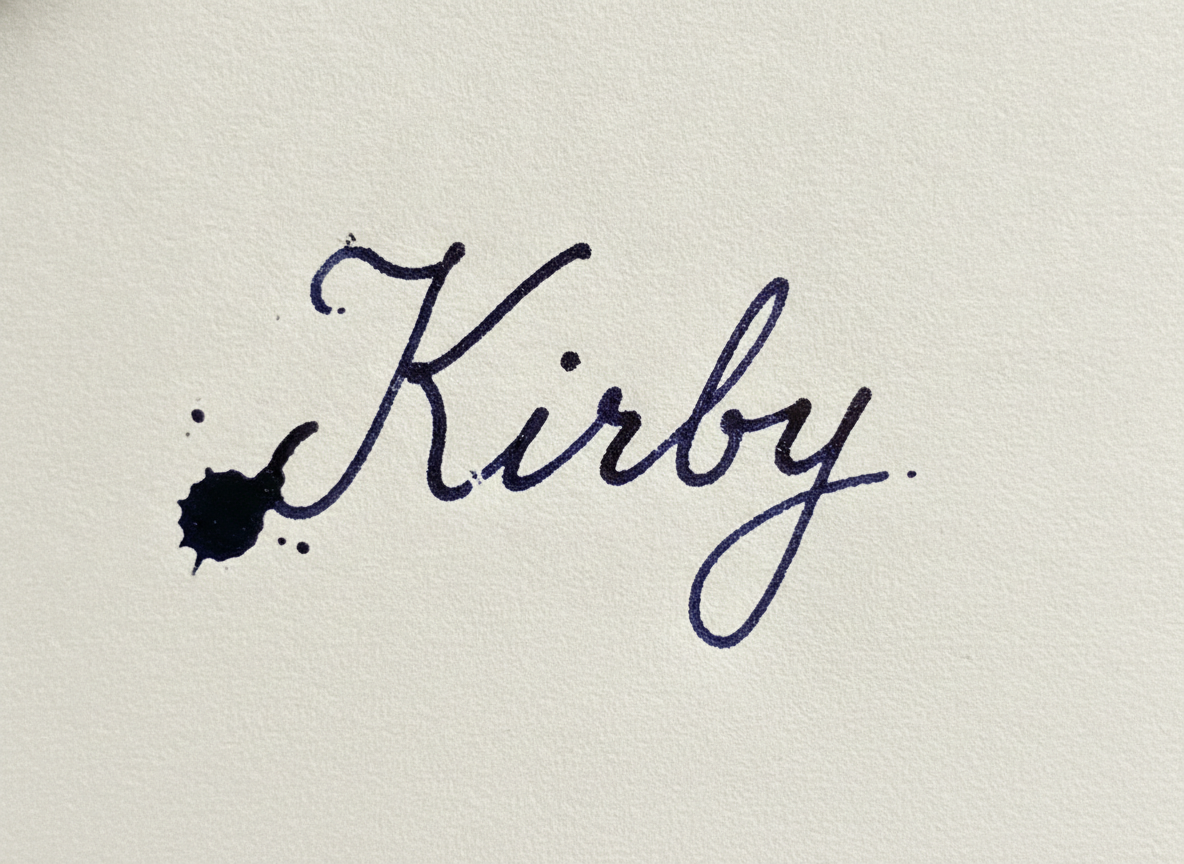
Kirby put down the pen and admired his signature. He'd been working on it for weeks. The cursive K was a real bear and all his life, he'd hated his treatment of the lanky, awkward letter. For the rest, he just mimicked his father's signature, Marty, close enough when elegantly scrawled. So it was only the K that he needed to sort out.
He held the paper aloft, took one last look at the signature, then passed the contract to the bank manager, who shot his paw across the desk and gave Kirby a healthy hand clasp.
"Well done, young man."
"Thank you, sir," Kirby said, but he was thinking that well done, young man seemed a strange token, measuring the performance of one borrowing money from a bank. There was an eagerness about the man, and the torsion of his handshake. Later, at the Lucky Loo, Kirby's local pub, his barstool neighbor, a perennial cynic named Larry, offered his insight.
"Son of a bitch let his inner monologue slip."
"What's that supposed to mean?" Kirby said, then peeled the cocktail napkin from the bottom of his beer glass.
"Congratulating himself for closing the deal. You ever sell someone a $10 bill for 40 bucks? Me neither, but that would be one of the best goddamn feelings I could imagine."
"If only," Kirby said, or huffed. "He knows perfectly well that balance will be paid in full by October. The fees will be nominal at best."
Larry let his semi-intentional giggle linger. It was the kind of giggle that cynics master in the earliest stages of their training as cynics. Then he caught his breath and capped the performance with a sigh of feigned gratitude.
"Imagine how many times that miserable, usurious son of a bitch has heard that."
Kirby fell sullen. It wasn't Larry's prognostication that weighed on him, but that the genius of his invention did not supersede any element of critique when it came to his finance plan.
The bartender approached, and within two seconds, communicating in nothing more than eye contact and head twitches, asked and confirmed that the two men would like another round.
Kirby hastily finished the last of his beer, eyeing the napkin stuck to the bottom of his glass.
"Don't listen to him, Kirby. I would buy one," said the bartender as he manned the tap.
"Thank you, Paul."
"Would!" Larry bellowed, slamming his empty glass onto the bar. "He would buy one. Theoretically."
"I wiillll buy one," Paul obnoxiously annunciated, then placed two beers in front of Kirby and Larry. "You really think you can get the patent by Labor Day?"
"Of course," Kirby said, his spirits already buoyed. "I know a guy."
The man Kirby spoke of was not a friend or former classmate. He wasn't even a random acquaintance. Rather, Jonathan Primo was someone who had come to live as a familiar in Kirby's mind, soon after he learned that Mr. Primo lived just 3.3 miles away from him.
Of all the states and cities and towns where U.S. Patent attorney Jonathan Primo could call home, what are the chances that he lived in Springfield, Virginia? This was a rhetorical question he had posed to Larry in the car, on their way to a Civil War reenactment in the Shenandoah Valley several months earlier. Rhetorical or not, Larry had a response.
"Given that the U.S. Patent Office is a government office, and Washington, D.C. the seat of our national government, I would say that narrows the odds considerably."
This pipped Kirby's enthusiasm, as Larry's retorts often did.
"Alexandria."
"Alexandria what?"
"The headquarters of the US Patent Office."
Larry gave a quick blast of the horn, as if the toot chiseled the odds even further.
"Well, there you go," Larry said.
Kirby slipped into a brood as the road descended into Thoroughfare Gap. Larry's eyes searched eagerly across the highway to their right, ready to make the same landmark comment that he made every time they passed this way.
"There, that railroad is the first railroad in the whole country to carry troops to battle. Hell, maybe the world even."
Kirby huffed, distant. "What are the chances?" he said.
"How'd you even know that? Where the guy lives? You stalking him?"
"No, I'm not stalking him. Geez."
"You got his home address."
The car veered toward the shoulder when Larry slugged Kirby in the arm and pointed to the ruins of a great stone structure huddled at the base of a wooded bluff.
"Imagine, in every one of those windows, snipers—ping, ping, ping—just plucking people off as they tried to make it through the gap."
"Wasn't that a mill, like for flour?"
"Well, sure, but not during the war. Then it was a prime sniper's roost commandeered by Lee's Army of Northern Virginia."
Kirby didn't challenge him, despite the fact that the minutiae of Larry's Civil War history were often extrapolations, assumptions, or outright fabrications. The road cut under the interstate and passed through a low area near a small brook. The depression seemed to heighten Kirby's own well-known depression.
"Bar Association," he muttered.
"What's that?"
"The Bar Association. It publishes the address and phone number of its membership."
"Their fucking home addresses?"
"If it's a home office, I guess so. So, no, I'm not stalking him."
Larry thought for a moment as the road took a long, slow climb. "Springfield, huh? So he probably lives in one of those classic late '60s split levels, two-car carport."
"He does, actually."
Larry blasted the horn. "I knew it." He laughed through twenty years of two packs a day gravel. "Fuckin stalker. There's laws against that, Kirby."
Now the laughter, or maybe the gravel choked Larry, and he coughed until his face turned as red as the tin roof of a general store that appeared at the crest of the hill. Larry spotted it, and reclaimed enough breath to say, "S'place has great ham biscuits. I'm stopping."
The woman at the counter was an old woman, and she had a look as if she had taken a long inhale and the force of the breath moving into her mouth, grabbed hold of her lips and it pulled them inward, and if she went on inhaling, it seemed as if she might suck the entirety of her face in through her mouth.
But she had a kind look about her.
Larry came for the Virginia Ham biscuits, which were on a wicker plate on the counter, covered by a mesh dome that kept the flies away. While Larry chatted with the old woman, Kirby set to survey the shelves.
Everything was neatly stocked. The labels were fronted, and the sparse supplies and the symmetry of it all made the goods seem more like art than a display of consumer goods.
Stores like this are disappearing, Kirby thought to himself. Where else will you find packets of multicolored children’s balloons right next to the duct tape right next to the women's hygiene products?
It was life right out there in the open and Kirby loved it and wanted to go back to the time when this was just a normal everyday store.
He collected a single tin of Vienna Sausages, not for their pleasing qualities as a food product but because his father always used to bring Vienna sausages on their fishing trips down the North Fork of the Shenandoah River, and what he remembered most about those trips aside from the sun and the humidity and the lack of fish was the persistent hunger, broken only when his father opened his satchel and removed two tins of Vienna Sausages and a sleeve of saltine crackers. It was precisely because Vienna Sausages were a food item that no one in their right mind would choose for an everyday snack, with their unique almost liquid texture and vague organ meat flavor, that the sludgy gray delights cast him back to those July afternoons so purely.
TO BE CONTINUED
If you haven't checked out my Substack Publications lately, and you don't have plans for the weekend, be my honored guest:
 Chip Warren
 Chip Warren