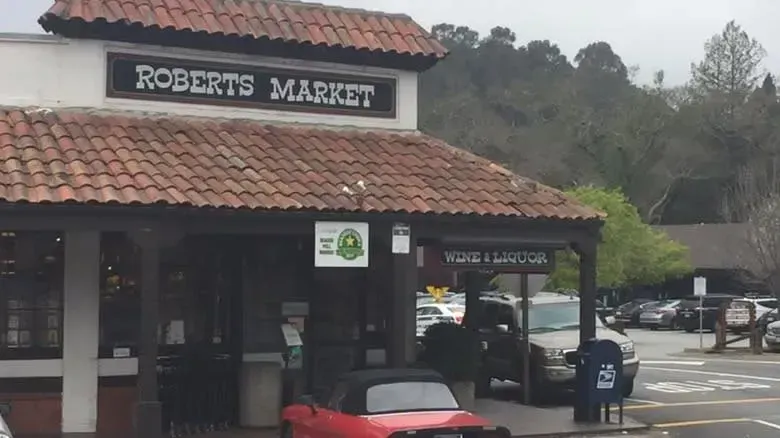
The store was overseen by the man bearing the Roberts name, whose father started the market as a butcher’s shop in San Francisco in the fifties. A huge mural covered the front wall above the cashiers showing the original store, and hiding off to the side, shyly leaning against a side of beef twice his size, was a seven-year-old George Roberts. No telling from the painting that the shy little boy grew up to be a stern taskmaster edging over six feet, with a forehead like the wraparound windshield of a ‘53 Buick.
When George walked through the store, silently scanning the displays for imperfection, your breath hung halfway in your throat, hoping his gaze would sweep past your domain and into the next. If he did pause and look somewhere, your attention shot to where he was looking and you’d make your way over as if you were already about to tend to it. He was tactful in his reproach — never any emotion in front of customers. Just a few calm words: “This could be topped off,” or “Let’s get these freshened up.” But you knew the mental note was made.
I feared him. But I didn’t dislike him. Which is what makes what I did feel so crummy looking back.
The primary concern of every teenager in my circle, come sundown, was where we were going to get our beer. By senior year of high school, the routine of hanging out at the liquor store asking strangers to buy for you got demeaning. We were smarter than that. And I worked on top of a gold mine.
In the cavernous cellar where the cases of beer were stored, light came in through window wells at ground level, opening to the alley behind the store. The windows were all protected with bars — except one. Below the bars was an opening in the wall that led to a hollowed-out space, maybe an old coal chute. A metal plate covered it from the alley side. Not locked. Not fixed.
Toward closing time I’d slip down to the cellar and slide a case of beer into the cavity, which seemed sized perfectly to accommodate a 24-pack of Budweiser. An hour after the store closed, I’d come back and collect it. Remarkably easy. I was modest in my withdrawals, and I didn’t tell a soul. A bottleneck at the coal chute would do no one any good.
But teenage hubris is a powerful thing. A close friend started working at the store, still a rookie bagger at the checkout stand. Since he ended up drinking a lion’s share of the stolen beer anyway, I figured the secret was safe with him. I showed him the whole process.
Two days later he was fired trying to swipe his first case. My beer scam came to an end.
I was not to be swayed. After letting the heat cool for a few weeks, a method to get fifths of liquor out the front door came to me.
Right after closing, the cashiers would count out their drawers and take them upstairs. To do so they had to pass through produce. As soon as they started to file by, I’d head to aisle one — the liquor aisle — giving the store a scan for managers on the way. If it was clear, I’d grab a fifth, usually rum, stick it under my apron, and walk to the back. Getting it out was the trick. Employees were welcome to help themselves to ice at the end of a shift — cubed or shaved. So I’d stand the bottle up in a clear plastic bag, fill it with shaved ice, throw on a twist tie, and walk out the front door with a perfectly shrouded bottle of booze. Plus, by the time you got to the party, your rum was chilled.
This worked beautifully until I took on an apprentice. Same friend. His persistence wore me down and I agreed to show him. The problem: two people doing it is twice as many as before and about ten times as obvious.
We each grabbed a bottle. We each put it in a bag of ice. We left the store and seconds later heard a manager behind us:
“Say, guys. You want to come back in here for a moment.”
The jig was up. I don’t recall what idiotic excuse was offered, if any. I just remember leaving the store moments later, not having been fired on the spot because all such matters had to cross George’s desk first. I would have preferred instant termination — a quick, painless death — to the anxiety of waiting for the sit-down with the Godfather.
The next day I reported to work looking as shamefaced as the dog that has chewed up the good shoes, shit on the floor, and eaten the wedding cake all on the same day. As a form of torture, I was made to work the first six hours of my shift before being called upstairs.
George’s brow was hanging lower than usual over his eyes. He looked pained. The son of a bitch wasn’t angry — he was hurt. This was worse than I imagined.
All he wanted to know was why.
He openly said I was the best he had and to let me go would hurt too much. He didn’t like the example it would set to keep me, but he didn’t want to lose me either. This was disconcerting — to have this pillar of intimidation open up that way. All I could do was open up right back. I had no answer for why. None that would make it make sense. I understood the ramifications of biting the hand that feeds, but not so well as until George Roberts spoke to me like an equal.
I apologized. Told him nothing like it would ever happen again. Whatever he decided would be understandable.
He gave me a second chance.
From then on it was straight and narrow. I worked there another six months and gave him the best I had. We bore something to one another after that. I had revealed my moral dilemma — an underage drinker whose social habits came first — and he had shed his stern demeanor long enough to listen. We understood each other a little better. He was still the boss. I still feared his surveying sweeps of the floor. We were by no means chummy. But when I found myself seated at George’s Thanksgiving table with his family three months later, I’d say the trust was restored well enough.
He was not a man ribboned with overt personal pride. He was simply proud of his store. As well he should have been. It was a fine place to work and a lovely place to shop. Albeit a little pricey.