I met Pablo at the drive-through window at the liquor store where I worked. He’d pull up in his Chevy Suburban, shirtless, a fantastic tattoo crawling up his chest and over his shoulder, red hair blazing, and he’d always order the same thing: a six-pack of Heineken. I’d pass it through the window and it would go straight into a cooler that doubled as his armrest. We’d talk until the person behind him in line lost patience and tooted their horn. That was the extent of it, a friendly face at the window, until one night when a little mescaline, serendipity, and desert madness brought us more closely acquainted.
My girlfriend and I had driven out to a rave at an abandoned airstrip twenty miles west of Tucson. We’d dropped a few orange barrel mescaline on the way. By the time we got there we were deep in the grips of it. Strobe lights turning minutes into seconds, seconds into hours, day-glow signs, writhing bodies, lollipops and pacifiers hanging from the lips of teenagers, heat waves rising behind them into a mute Sonoran landscape.
Hours later, as the edge of the mescaline melted away, we decided to leave. If we hauled ass we could make it back for last call at our regular bar, maybe even a couple games of pool. But a mile beyond the airstrip we stopped at a Circle K for beer, and something ruptured between my girlfriend and me. It was one of those fights whose topic is forgotten almost immediately. She stormed inside to buy the beer and cigarettes. I walked out into the fringe of the desert scrub behind the store to take a piss, and just kept walking. Serpentining through the palo verde and prickly pear, dodging the occasional saguaro, making my way to total invisibility.
I could see her come outside, walk to the car, get inside, then get out and scan the parking lot. She knew me. She knew that when a social situation became uncomfortable, I’d ghost. I would have left me, too. I watched her taillights disappear toward the glow of Tucson.
There’s a certain freedom that comes with giving yourself over to a more pleasant reality, even if that pleasant moment is standing in the desert under a brilliantly starry sky with no way to travel the fifteen miles that separate you from your bed. With the rave winding down, cars would start trickling by on their way back to town.
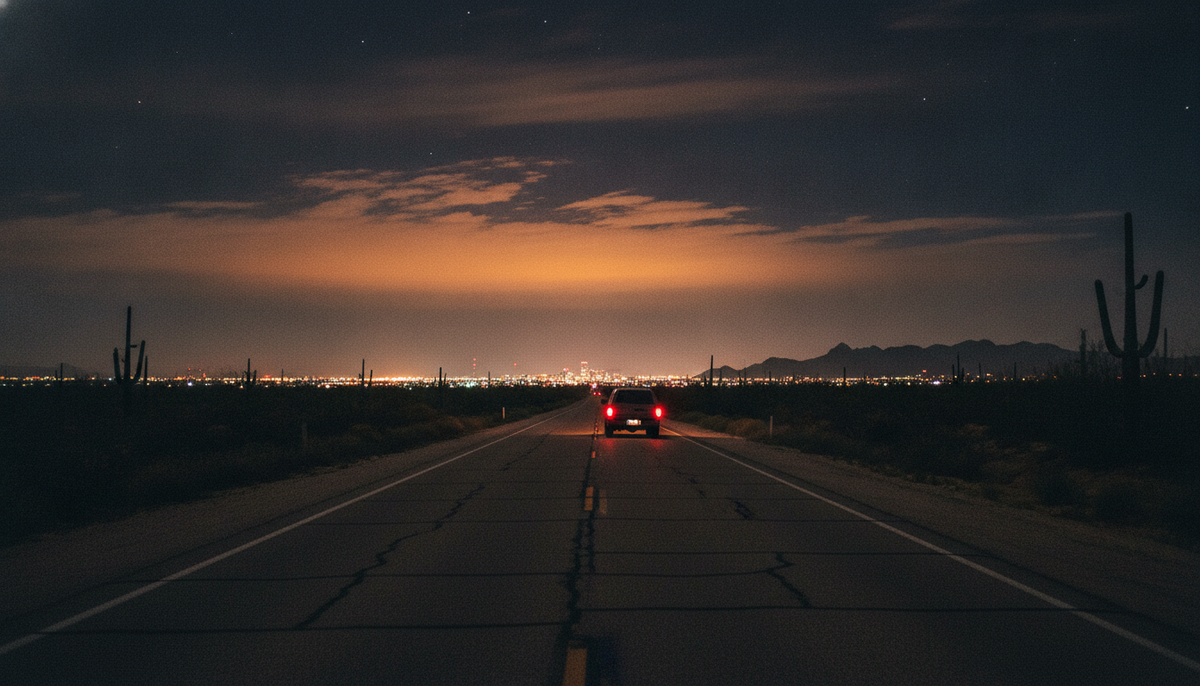
I started walking. Alternating between pavement and gravel shoulder, sometimes to give a car full of wild-eyed ravers barreling down the two-lane a wide berth, sometimes finding a new line after the chemicals disrupted whatever fluid in my inner ear helps me keep my bearings. It was a beautiful perspective on the night, the Tucson Mountains silhouetted by the lights of the city, the stars, the breeze pushing in from the West.
The only problem: I was still about 14.25 miles from town and the cadence of cars streaming by was beginning to slow. I knew what two hours from now was going to feel like, so I stepped to the edge of the blacktop, faced a pair of oncoming headlights and leveled my thumb.
A gargantuan vehicle passed, but then pulled to the shoulder and skidded to a stop in a cloud of dust. It was the Suburban. A flame of red hair shot out the driver’s side window.
“Need a lift?”
I hopped in. Before I could buckle my belt, Pablo reached into his igloo armrest and fished out a painfully cold Heineken. As he handed it to me the label peeled away and fell into a gummy clump on my shorts. He pulled the keys out of the ignition — mind you, we were barreling down Route 5 at 75 miles an hour in a twenty-five-year-old Suburban — cupped his hand over the top of my beer and with a WHIFF-LUMP the cap flew out the window into the desert night. The beer cut a cold path straight down my esophagus to my stomach.
“Goddamn that hits the spot.”
“You hitching back from that rave? I didn’t see you there.”
“Hitching, sort of. I got into it with my girlfriend and things seemed a lot more pleasant outside the car than in. So I got out at the Circle K.”
“You’re high as a motherfucker, aren’t you.” He reached above the sun visor and pulled out a joint, pinched it in his lips, and lit it. And that was the beginning of the friendship, one rooted in drugs, music, and submarine sandwiches, and held together with a weird bond of trust that was stronger than any I’ve ever felt.
Less than a week later, the pneumatic bell rang and before I could spin from the register I saw his Cheshire smile from behind the dusty window. I grabbed a six-pack of Heineken from the walk-in and handed it through the sliding window.
He eased to the window and before I could say hello, he said, “We’re going to Vegas on Friday. Can you go?”
“Dead shows?”
“Yeah, man.”
“Let me make a couple calls. How can I reach you?”
Pablo dumped the beer into his cooler, wrote his number on the six-pack carton and passed it back in with a ten-dollar bill for the beer. I took the carton and passed the ten back. I covered Pablo’s six-packs for as long as I held my tenure at Rincon Liquor. Karma’s rules, not mine.
I can’t write about a drug-addled road trip to Las Vegas without summoning the fancy devils of one of America’s greatest modern novels. This was not a deliberate reenactment of Hunter Thompson’s classic, for no amount of fear and loathing could ever match the mystical truths he left hidden under hotel mattresses and in casino bathrooms. What we shared was the festive enthusiasm for a hell-bent road trip into Sin City, but we weren’t drilling into the heart of the American Dream. We were going to see the Grateful Dead.
Pablo had borrowed the RV from his girlfriend Rosa’s uncle and they stocked it with two jumbo coolers of beer, one pill bottle of orange barrel mescaline, another two of cocaine, and a pound of marijuana. The weed was the lifeblood of the trip, to be peddled to the hordes of steaming hippies that comb the parking lot in search of peace, falafel and an ever-expanding hacky-sack circle. Everything else was for our own mind-muddling.
Pablo, Rosa, Jaime, and I were on our third beer before the lights of Tucson disappeared in the rearview. The bottle of cocaine made the rounds as we blazed through Marana toward Pacheco Peak, the RV full of Santana. Then something strange happened, and for the sake of my own literary persona I should lie about it, but I can’t. One hour into the trip, I fell fast asleep and slept for the next three hours. Every once in a blue moon cocaine throws me a curveball and reverses its effects. Thank god its first cousin Novocain doesn’t have the same sense of humor, Hey Doc, I’m feeling something! Hey Doc, HEY DOC!
When I woke up we were following a ribbon of two-lane blacktop between Phoenix and Kingman. Jaime was reading. Rosa was in the passenger seat, her head bobbing to a scratchy recording of “Me and My Uncle.”
“Mornin’!” Pablo spotted me in the rearview.
“Time is it?”
“Ten till twelve,” Jaime said. “You went out just after nine.”
Pablo cracked a beer between his clamped thighs, handed it to Rosa. She reached under her seat for the cosmetic bag, pulled out the bottle of mescaline, and dropped an orange barrel into a bottle of beer and passed it to me. I held the bottle up to Jaime’s reading light and watched the little orange pellet swim around at the bottom spawning a flourish of tiny bubbles. Thumb in the neck, I upended it, flipped it back, and swilled half the beer in a single go.
My little nap through Phoenix was the last sleep I would enjoy for the next 56 hours. I say ‘enjoy’ because there was one vain attempt to sleep the following night in a Vegas hotel room hosting no fewer than 23 desert-addled people trying to crash, each in the grips of one or another of every intoxicant known to early-90s college students. I was in the closet lying next to a granola chick that I didn’t know and would never formally meet and every time I tried to close my eyes a kaleidoscope of animated characters, all rendered in a late-50s early-60s Disney-style, would begin some maudlin, lusty dance on the back of my eyelids. It was a wonderful display, but it kept me on the hallucinogenic outskirts of sleep for the rest of the night. At some point close to dawn, whatever the hippie ate that afternoon at the Red Stadium parking lot turned on her, I got the hell out of there for fear the wallpaper would start peeling away, binding us up like mummies, while we choked to death in a cloud of lady methane.
This was the first time I lost Pablo.
I stumbled out of the room, cued by the hey-watch-it’s and turn-off-the-fucking-light’s in a register of familiar voices that indicated the room was populated by another circle of Tucson friends (and whatever rag-tag-tagalongs swelled the room until it looked like some kind of detention facility.)
I took the elevator down to the casino, still clueless about what time it was. I felt like death frozen over. My head was pounding and my mouth felt like I slept face down, mouth open, lips fixed on the Nevada salt flats. The casino was popping and lively, just as it was twenty-four hours a day. The sad smattering of people hunched at the video slots indicated that we were all deep, deep into another miserable Vegas night.
I found a restaurant with a breakfast buffet going so I knew it must be somewhere near dawn. Downing coffee, orange juice and a plate of eggs that were scrambled into oblivion only worsened my condition. Twenty minutes later it all came up and as I splashed water on my face in the Circus Circus lobby bathroom, I tried to call up the events that had led me here. But the details were sparse. I remembered sitting on the top of the RV after the show. A group of friends walked by. I hopped down and walked off with them and then the next thing I knew I was in the back of a pick-up truck barreling toward the strip. Then I remembered the bottle of tequila that was passed around the bed of that truck. I thought I tasted something more than coffee and eggs in that last heave. It was all coming together like a DIY jigsaw puzzle. Mescaline, cocaine, weed, and tequila. Like some mythical Bacchanalian brain orgy, and like most orgies (I imagine) it all started with more fun than it ended.
When the Dead was in town, early-90s Vegas was something to behold. Every casino on the strip was overrun with stinky hippies sleeping 23 to a room, working the system for cheap food, cheap rooms and free drinks, for less than the cost of a KOA site. This was before the Vegas renaissance turned the strip into a massive shopping mall. Casinos lured people to town with $20 rooms, leaving their pockets full to get lost and emptied at the tables. But the Deadhead is a unique specimen. The Deadhead is the only patron that, across the board, Las Vegas loses money on. I have no doubt pit bosses everywhere danced a jig when Jerry finally kicked the bucket.
That day at the show, I stood along the top row of the stadium where a sharp wind kept the heat bearable. Somewhere around the space-drums segment, a storm rolled in, lightning dancing on the mountains behind the stage. When a bolt came down on the parking lot side, a hush fell over the crowd for a split second, followed by the biggest cheer yet. The band paused, milled about on stage wondering whether to take a break, while paramedics were rushing to where the lightning was still working its way through the nervous system of a twenty-year-old kid lying in the dirt. The ambulance whirred him off to Vegas Memorial and the show rolled on.
I never heard what happened to that kid. And I never found Pablo.
On the drive home, the same people who had barreled toward Las Vegas days before, arms entwined and heads out the windows, sharing a hallucinogenic daze, were now wedged against each other in the back of Celicas, Golfs, and Civics, cursing the lack of leg room and begging for a stop to take a leak or worse. I was in a guy I knew from Anthro class’s Honda Prelude and delighted to have the driver’s seat. I only nodded off three or four times.
There is an immense rise that always precedes total collapse. It’s marked by the feeling of total invincibility and was, in this case, fueled by the panting snores of people who have succumbed to the gravity of a bender. I was full of raw determination.
I persisted! I survived! I was still standing and I was ready for anything!
The fact that I was heading back to Tucson, behind the wheel of a totally unfamiliar car with semi-familiar friends, having abandoned my original crew, was the outstanding evidence that I knew how to grab a weekend by the horns and hold on for dear life.
That lasted until about forty miles outside of Tucson and I knew that my bed was waiting somewhere beneath the city glow. The last ten miles were the most painful but when I finally found myself nestled between familiar smelling sheets, my final thought before drifting off was this:
What the hell happened to Pablo?
The next few months Pablo and I hung out and drove around south Tucson, hitting the out-of-the-way taco stands that were usually the domain of barrio locals. Pablo would always have a few stops to make ‘for work’, but mostly we just cruised around during the late afternoon, catching a flick now and then, anything to escape the wicked heat of the Arizona summer. As far as the Vegas trip went, he remembered about as much as I did.
Of my abandonment, he quipped, “You’d have to be a leper or a priest to not be able to find your way back to Tucson from Vegas, and given that you’re neither, I knew you’d get home OK.”
I had to correct him. These are neo-hippie Deadheads we’re talking about. I could be the goddamn pope, covered in sores, with one arm and an ear about to drop off and they’d still give me a lift. Hell, they’d probably let me ride shotgun.
Then, just like that, a year went by. In the intervening months, I moved to the East Coast to try my hand at professional archaeology. Who knew there was such a thing. It went well, but eventually it got pretty boring, so I packed up my Volkswagen Thing and headed back to Tucson to try my hand at graduate school. I immediately fell in with Pablo. Jaime was off in Oaxaca for the summer, so that left the two of us. And Rosa, of course.
I was short on money and shorter on work. The archaeology job I’d lined up before I returned had evaporated. One afternoon over a submarine sandwich, Pablo asked why I didn’t peddle a few bags. With the density of potheads in this town, he said, I’d never have to sell to anyone I didn’t know. He was right. He conveyed a pound of orange-hair Mexibud and I was up and running. Every sale happened in my living room. No overhead, no advertising, no taxes. I was clearing a hundred dollars a day for about thirty minutes of work.
To fill the rest of the hours I picked up a few shifts at the liquor store, wholesale beer being a reasonable perk, and sat in twice a week on a Roman history lecture at the university. For the first time in my life I had schedule that suited me perfectly. Twenty hours of obligation a week, and the rest at Pablo’s foothills condo with occasional runs down to the Gulf of California when the desert heat became unbearable and we needed saltwater and seafood.
Rosa was a sweetheart with the mindset that belonged more in 1968 than 1993. She sewed her own skirts, made pot brownies, took care of her man, but was fiercely independent and quick to spike any notions that selflessness offered to one’s mate was really submission. “It’s love, baby,” I heard her say once, “and you obviously don’t know a thing about it.”
On one such trip to Puerto Peñasco, Pablo and I were on the terrace of a seaside hotel, working through plates of deep-fried cheese with mushroom gravy and watching the sun go down over the Sea of Cortez, when a well-dressed Mexican man came up the beach steps with a blonde on his arm. He glanced at our table and his face broke open.
“Holy shit, Rincon Liquors guy!”
It was Carlos, a regular from the drive-through. His standing order was two bottles of Cristal, which told me what I needed to know. I’d been giving him the regular’s ten-percent discount without thinking much of it, and he’d once thanked me by leaving a tip of a nugget of kind bud and a fifty, speeding off before I could thank him.
He noticed Pablo. “You’re Ricardo Mez’s boy?”
Pablo flicked his chin, extended a hand. “Pablo.”
We chatted for a few minutes, small talk, an accounting of life’s coincidences. Pablo mentioned that Rosa believed there was no such thing. When Carlos left, Pablo leaned across the table and whispered, “Dude’s one of the biggest importers in the Southwest. Nothing comes across without him knowing about it.” This was ‘94, pre-cartel days, but still.
I asked Pablo how his father knew Carlos. He said his dad was a cop and didn’t say much more, but via bits of conversation I clocked later, I gathered that his father was a good man working a hard job on the border. I didn’t need to pry. It was enough to presume that the symbiosis that kept people living close to the boundary between Arizona and Mexico in harmony was more nuanced than your average citizen could really understand. His dad knew Carlos, Carlos knew him. Men like Carlos knew better than to create problems for the families around him, as did Pablo’s dad.
There was nothing dramatic about how Pablo and I came to trust each other as much as we did. To care for each other as friends. No single moment. It grew in silences, in what went unspoken, in the accumulation of unasked questions. Bit by bit, he came to know me and I came to know him, and he never said, “oh by the way...” Rather he just hid less from me. He stopped short of saying that through his dad, he had connections and he had suppliers, and he facilitated certain product reaching the eager streets of Tucson. And to me, it didn’t matter. The trust, the mutual respect, and just the goddamn essential bonds of friendship that mattered. Maybe it was like that with Carlos and his dad. Everyone has a basic need for human intimacy. It’s easy to diminish the friendship shared between, say, prostitutes or mob bosses, or to condemn them as friendships of necessity. But no, friendship is just friendship, and it serves something in us to receive it, and to offer it, as well. At least that’s what I sense looking back on my friendship with Pablo.
The last time we spent time together started one afternoon when I was lying in the dirt, adjusting the valves on my Volkswagen. He pulled into the driveway, grabbed a couple of beers from his truck, and sat on an overturned bucket while I worked. I could tell right away something was off, but I didn’t press him. When I finished the last valve, he handed me a shop towel and the other beer.
“Everything okay?”
“Got some bad news from L.A. yesterday. Guess I haven’t quite shaken it.”
He asked me if I would drive down to Bisbee with him, for a family dinner. Not if I wanted to, but would I. I clocked the difference and I said yes.
Crossing the high plain toward Sierra Vista, Pablo told me how a friend had died, two days earlier. The guy was driving west on I-10 into Santa Monica, talking to his girlfriend on his mobile phone, when he must have taken his eyes off the road long enough to come up on traffic stopped dead at an off-ramp.
“His girlfriend heard him say, oh, and then nothing. Hit the back of a semi doing seventy, said he didn’t even brake.”
We drove on in silence. He stared out across the amber grasses of the high desert. I could see from the corner of my eye that he was crying. I didn’t look at him. I didn’t put my hand on his shoulder. I didn’t say a word.
Ten minutes went by before he quietly thanked me and reached into the cooler.
A few months after I left Tucson for the last time, I called Pablo from a Forest Service bunkhouse in Alaska. He was in a slump. Rosa had moved to Oregon. He was thinking about San Diego, living on the beach, pitching a new angle on life. When we got off the phone I felt an emptiness in my gut, and I knew that he did too. The part he didn’t say: Rosa was gone, Jaime was still in Mexico, and you’re way the hell up in Alaska. You’re gone, too. He really needed a long, quiet drive through the desert more than an idle long-distance conversation over a scratchy phone line.
A few weeks later, Jerry Garcia did finally die. I gave Pablo a call to share a moment of silence. A three-tone ditty played in my ear. This line is no longer in service. I tried his pager. Same. Knowing how adept Pablo was at covering his tracks, I left it at that and never saw him again.
Wherever you are right now, Pablo, wherever the sun is glinting in those green eyes, I wish you well. I’ll hold a moment of silence in your honor and think of days to come.